

Indraprastha Gas Limited Sees CNG Surge As Middle-Class Drivers Pivot From Costly EVs
Driven by a 40% to 50% reduction in running costs compared to petrol and diesel, CNG has firmly established itself as the primary fuel for India’s price-sensitive middle class.
The Gist
- CNG offers a 40% to 50% reduction in running costs compared to petrol and diesel.
- IGL manages a network of 30,000 km and accounts for 24% of CGD volume sold in India.
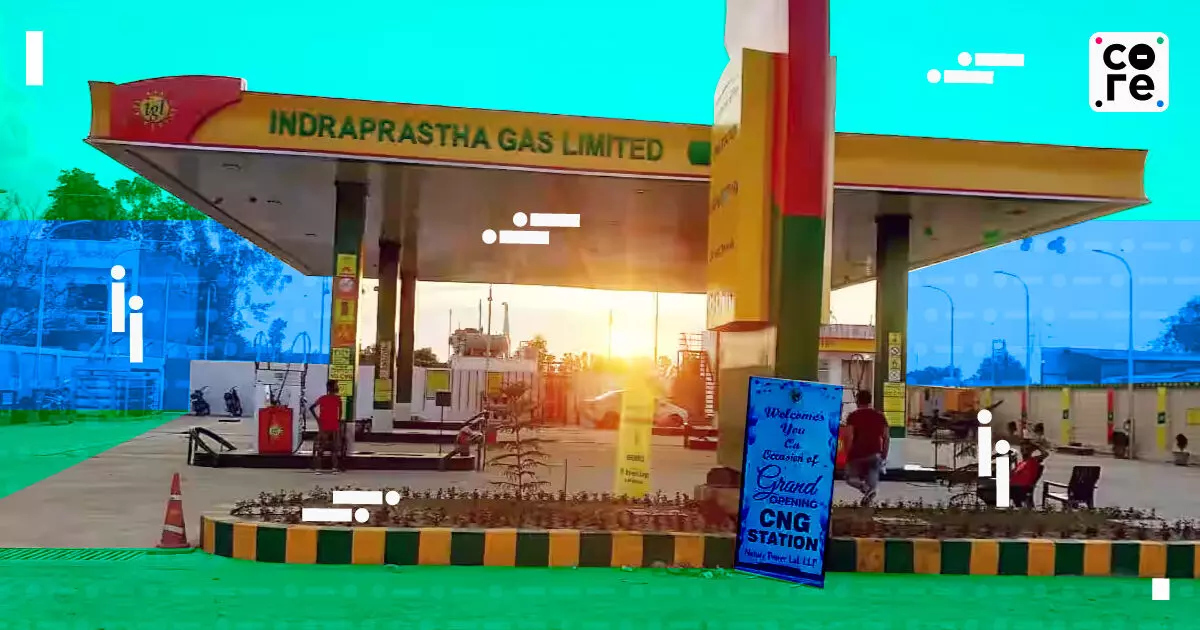
- In Delhi, CNG stations now outnumber traditional fuel outlets, significantly reducing consumer wait times.
Indraprastha Gas Limited (IGL), India’s largest city gas distribution (CGD) company, is reporting a significant shift in the country's mobility landscape, as compressed natural gas (CNG) adoption outpaces traditional fuels in several key segments.
Driven by a 40% to 50% reduction in running costs compared to petrol and diesel, CNG has firmly established itself as the primary fuel for India’s price-sensitive middle class. IGL, which manages a robust network of approximately 30,000 kilometres of pipeline, now accounts for nearly 24% of the total CGD volume sold across the country.
Economic Advantage Drives Adoption
Kamal Kishor Chatiwal, Managing Director of IGL, told The Core in the run up to Indian Energy Week that the historical hesitation surrounding gas-powered vehicles — rooted in myths about power loss on hills or flyovers — has largely dissipated. Improved kit technology and a widening price gap between gas and liquid fuels have turned CNG into a dominant market force.
"Over 75% sales is in CNG segment, because that's the major volumes is going over there," Chatiwal said, noting that the company is on track to exit the fourth quarter with sales reaching 10 million units.
In the capital city of Delhi, the infrastructure has reached a tipping point where CNG stations now outnumber petrol and diesel outlets, with 500 gas stations currently operational. This expansion has drastically reduced wait times for consumers from half an hour to as little as two to five minutes.
The Middle Class Fuel vs Electrification
While the automotive industry faces increasing pressure to electrify, IGL reports that CNG maintains a "strong grip" on the entry-level to mid-range vehicle segments, typically those priced up to 20 lakhs. While electric vehicles (EVs) have gained traction in the two-wheeler and luxury segments, the high capital cost remains a barrier for the average consumer.
"Now, people have realised that there is a huge, huge advantage, because customers, you know, they don't realise the advantage of sustainability, environment, they're more concerned with the economics,” Chatiwal said, explaining the current market dynamics.
Data suggests that the running cost for an entry-level CNG vehicle is approximately 3 rupees per kilometre, compared to 6 rupees for petrol. Although EVs offer a lower running cost of nearly Rs 1.5–2, their capital cost remains 30% to 40% higher than their gas-powered counterparts.
Market Growth and Future Outlook
The growth in CNG is not merely coming from new vehicle sales but also from a steady stream of petrol-to-gas conversions. IGL's data indicates that the fuel is now competitive enough to challenge the traditional dominance of liquid fuels in the National Capital Region.
"We find that in some of the months, we find that the CNG sales, the total conversion plus the new vehicle sale is more than petrol and diesel also," Chatiwal said.
Beyond urban centres, IGL is expanding its reach into rural Haryana and Uttar Pradesh, bringing piped natural gas (PNG) to villages. The company is also exploring international opportunities, having bid for distribution networks in Saudi Arabia and attracting interest from Nigeria to help convert 10 million vehicles to CNG.