



 Newsletter
 Search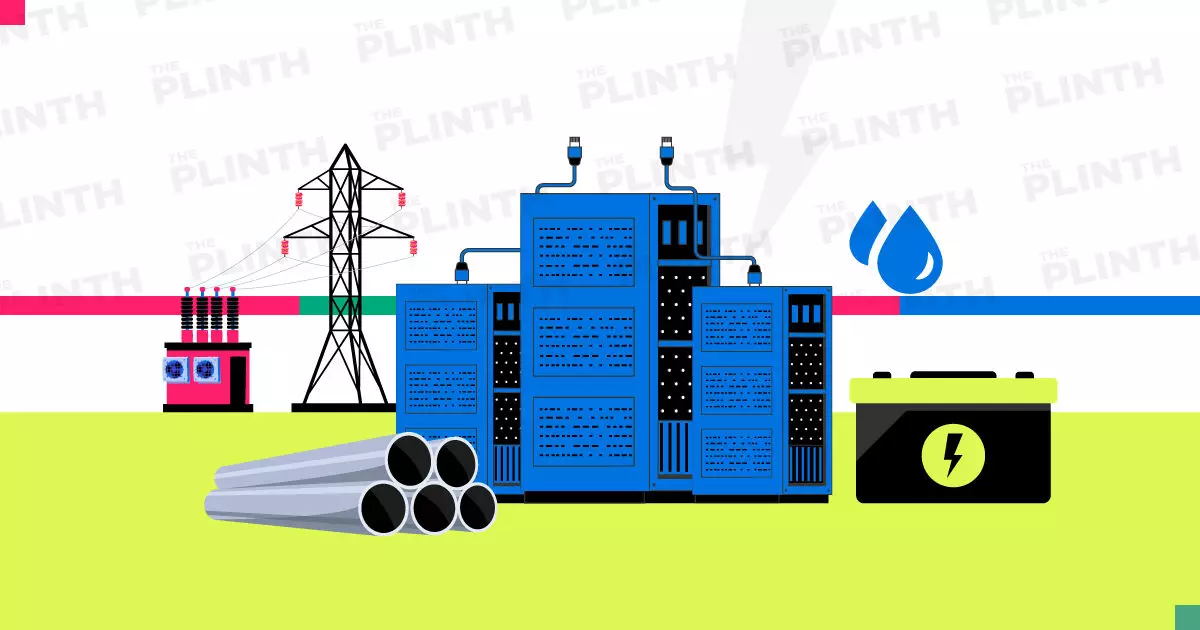
India’s Data Centre Dream Faces A Supply Chain Reckoning
- The Plinth
- Published on 16 April 2026 6:00 AM IST

The compelling projections and investments will not help close the multiple supply chain gaps, each with its own queue
India's data centre sector attracted $56.4 billion in fresh investment commitments in 2025 alone as total installed capacity crossed 1,700 MW. CBRE projects 500 MW of new supply in 2026, and the government's target of 9 GW by 2030 implies a fivefold expansion from current levels.
The capital has been committed, and the policy framework has improved materially. Deserving more scrutiny is the supply chain that must deliver the physical infrastructure behind these projections.
In early February, Zhao Haijun, co-chief executive of China's largest chipmaker SMIC, offered a pointed reference point. Companies, he told analysts, built ten years' worth of data centre capacity in one or two years, but what those data centres would actually do had not been fully thought through. He was alluding to China's overbuilding episode: government-backed facilities in that country’s western provinces running at 20–30% utilisation, unable to find tenants.
The warning was addressed to the global buildout. But the supply chain dynamics it exposes apply to India as much as anywhere.
India’s data centre narrative has several missing links: transformers, switchgear, and CRGO steel on the electrical side; liquid cooling and GPU allocation on the compute side; and battery backup reliability, water, commissioning labour, and subsea cable concentration that barely register in the conversation.
The Announced Ambition
Cumulative investment commitments in India’s data centre pipeline stood at $126 billion at the end of 2025. They are projected to cross $180 billion in 2026, a 45% year-on-year rise.
Mumbai alone accounts for more than half of the current operational inventory; Mumbai, Chennai, Delhi-NCR, and Bengaluru together hold nearly 90% of tier-I city capacity. Maharashtra, Telangana, Andhra Pradesh, Tamil Nadu, and Uttar Pradesh are all competing for the next wave, with tier-II cities attracting growing interest. The government's 9 GW target by 2030 would place India among the world's largest data centre markets. Electricity consumption is projected to rise from 10–15 TWh to 40–45 TWh over the decade.
Behind these figures sits a supply chain that has not been examined with the same rigour as the demand assumptions underwriting it.
The Electrical Gap
The most acute near-term constraint is electrical infrastructure. Transformers, switchgear, and battery storage account for less than 10% of total data centre capital expenditure, but they are non-negotiable. In the United States, lead times for high-power transformers that ran 24–30 months before 2020 have stretched to five years today, with prices doubling.
As American builders turned to China, transformer imports rose more than fivefold between 2022 and October 2025. China accounts for over 40% of US battery imports and near 30% of transformer and switchgear categories. That relationship is now disrupted by tariffs. Nearly half of the US data centre builds planned for 2026 are projected to be delayed or cancelled as a result.
India faces the same global queue, with a thinner domestic manufacturing base. Core electrical equipment is still heavily import-dependent; procurement cycles routinely stretch beyond twelve months.
A hyperscale campus in Navi Mumbai or Hyderabad requires transformer orders placed long before construction begins. Project timelines for transmission work have already slipped from 18–24 months to 30–36 months due to supply pressure. Developers are now accepting early deliveries and storing equipment on site simply to hold their place in the manufacturing queue.
Switchgear presents a more nuanced picture. Low and medium-voltage equipment is largely manufactured domestically — Schneider Electric, ABB, Siemens, and L&T all produce it in India. High-voltage gas-insulated switchgear required for the grid connections of large hyperscale campuses, however, is predominantly imported. Their lead times and supply constraints mirror the transformer problem.
Behind both sit cold-rolled grain-oriented (CRGO) steel, the primary raw material in transformer cores. India currently imports CRGO almost entirely from Japan, South Korea, and China. Benefits from JSW Steel's acquisition of Thyssenkrupp's Nashik facility in January 2025 and the planned expansion to 3,50,000 tonnes arrive in FY2028. By then, most of the projects currently being underwritten will have already hit their commissioning deadlines.
The Cooling Problem
As GPU rack densities rise toward 100 kW and beyond, air cooling becomes insufficient. Liquid cooling — direct liquid cooling, immersion cooling, rear-door heat exchangers — is the engineering answer, and it is almost entirely import-dependent. The domestic manufacturing base is thinner than for transformers and has not attracted equivalent policy attention.
This matters because the cooling infrastructure must be in place before high-density GPUs can operate at their intended rack density. A facility built with air cooling cannot run H100s or Blackwell chips at full capacity, regardless of how many it secures.
Which raises the second problem: securing those GPUs in the first place. India's data centre ambitions are predicated on filling facilities with Nvidia H100, H200, and Blackwell-generation chips. These are all subject to US export controls and allocated through a queue that has historically favoured large American hyperscalers. An Indian operator building 100 MW of AI-ready capacity has no guarantee of receiving enough of them.
The two constraints compound each other. A facility that cannot cool high-density racks and cannot fill them with the right compute will end up running conventional cloud workloads at lower rack densities, underperforming the economics that justified the original investment.
Invisible Queues
Four further constraints receive almost no attention in the investment narrative. The first is battery backup. AI data centres require round-the-clock power reliability that diesel cannot sustainably provide at scale. Lithium-ion is gaining ground — Amara Raja and others are supplying the market — but battery energy storage systems currently provide only two to three hours of peak backup when paired with renewables, well short of what large AI facilities need. Gas-based backup, the logical alternative, is constrained by India's thin gas distribution infrastructure.
Nikhil Kumar, Managing Director of TD Power Systems, had noted on the company’s Q2 earnings call that he saw little ground-level investment in large AI data centres in India, and that it would remain a question mark until the gas availability problem is solved.
The second is water. High-density AI data centres in Chennai and Hyderabad, both water-stressed cities, require significant cooling water, yet regulators have not addressed this systematically, and the electricity conversation has crowded it out largely.
The third is commissioning labour. India trains electrical engineers in volume but not the specialised data centre commissioning engineers — critical facilities engineers, MEP commissioning specialists, high-voltage switching operatives — that hyperscale operators require. This becomes binding as the pipeline moves from announced to under construction.
The fourth is subsea cable concentration. Mumbai's dominance in the market is partly a function of its cable landing stations. As capacity expands to tier-II cities, the latency and resilience assumptions underpinning those builds need honest examination. A data centre in Bhopal or Patna does not have the same connectivity profile as one in Navi Mumbai, and AI workloads that require low latency will not migrate there on the basis of cheaper land and power alone.
What Is Being Done
The policy response is unevenly distributed. JSW Steel's CRGO expansion addresses one upstream bottleneck. The government has committed Rs 9.6 lakh crore in transmission capex through 2032, PLI-style incentives for electrical equipment are under discussion, and BIS testing facility expansion would shorten certification lead times. CG Power's management has flagged a structural demand shortfall through FY2029-30 even after all planned domestic capacity additions. It’s a signal that the industry itself understands the gap.
A coordinated response to the non-transformer constraints, such as liquid cooling, GPU access, battery backup duration, water regulation, and commissioning labour, has no policy equivalent of the CRGO investment or the transmission capex commitment. These are being left to the market, and the market's timeline is slower than the investment pipeline assumes.
A Narrative With Several Missing Links
The demand side carries its own uncertainty. India's data localisation mandates and public sector cloud migrations create a genuine policy floor — companies storing Indian user data must keep it onshore, and that is real contracted demand. But 'better than China's western data centres' is a low bar.
China's facilities also had a floor set by state-owned enterprises and government institutions as anchor customers. That floor delivered only 20–30% utilisation.
India's floor is structurally sound, but a significant portion of the $180 billion in commitments is being placed speculatively, on the expectation that enterprise AI adoption, hyperscaler inference demand, and public sector workloads will grow into the capacity being built.
Moody's projects global AI infrastructure spending will exceed $3 trillion over the next five years. The top four hyperscalers are expected to spend over $650 billion in 2026 alone. That capital is chasing applications that remain unproven at the utilisation rates. Investment is running well ahead of the policy demand floor
For India, the honest framing is that the sector has moved from potential to performance, but performance at 1.7 GW is a long way from a $180 billion pipeline targeting 9 GW.
The distance between committed capital and commissioned capacity reflects not one missing link in the supply chain but several: transformer lead times running to five years, switchgear on the same queue, CRGO steel supply constrained until FY2028, liquid cooling with no domestic manufacturing base, GPU allocation subject to US export controls, water regulation not yet fit for purpose, and commissioning labour structurally short. Each has its own queue. None is being addressed at the speed the investment pipeline assumes.
Core.
Core.


