



 Newsletter
 Search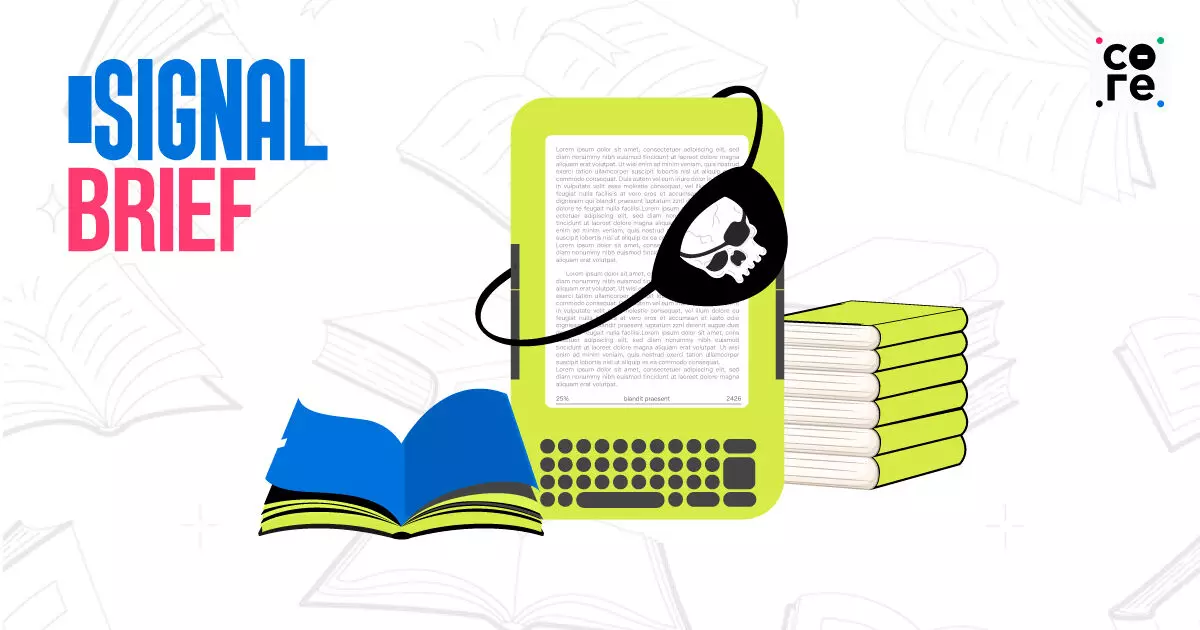
Does Piracy Help Readers Or Hurt Us All?
- Podcasts
- Published on 3 April 2026 7:30 AM IST
On Wednesday, March 25th, the Delhi Police seized over 20,000 counterfeit books from a printing press in Rohini.
Soon after, Penguin Random House India published a statement saying that it had helped the cops with information.
Online, the reaction was mixed. Some appreciated this step, calling it a necessary crackdown on piracy.
Others, however, had a totally different opinion. They said that buying pirated books is often the only way many in India can read.
Sunidhi, a Master’s student studying Physics, said the same thing, when met her at Mahila Haat. That she just cannot afford original editions of books.
So who’s right? The publishers protecting authors.. or readers just trying to to read?
To find out, check out the latest episode of The Signal Brief.
The Core produces The Signal Brief. Follow us wherever you get your favourite podcasts.
NOTE: A machine transcribed this episode. A human has looked at this text but there might still be errors. Please refer to the audio above, if you need to clarify something. If you want to give us feedback, please write to us at [email protected].
TRANSCRIPT:
Kudrat (Host): Last week, on Wednesday, March 25th, the Delhi Police stormed into Rohini Sector-16 and wrapped up a nearly 24-hour operation. They seized over 20,000 pirated books: crisp counterfeits of Sapiens, Murakami novels, and novels by authors like Simon Sinek, James Clear and Arundhati Roy.
They shut down an illegal printing press and arrested 67-year-old repeat offender Jwala Prasad Soni.
Soon after, Penguin Random House India posted a strong statement about the crackdown. The publisher revealed it had collaborated with Hay House and Simon & Schuster India to help the police build the case.
Manoj Satti, Senior Vice President at Penguin Random House India, declared: “Piracy is not a victimless crime—it directly impacts authors, publishers, readers, and the broader creative ecosystem.”
The response on social media was sharply divided. Some applauded Penguin and the police, calling the raid a much-needed strike against organised piracy.
Others pushed back hard. They argued that piracy makes books accessible in a country where original editions are unaffordable for most. They pointed to derelict libraries, disappearing from cities each day and asked: who are we really punishing: the pirates or the readers just trying to learn?
Industry estimates suggest that India’s book market is worth around 80,000 crore rupees. And, pirated books account for 20-25% of that pie. That means nearly one in every five books sold in India is a counterfeit copy.
Make no mistake: book piracy is illegal in India, but it thrives as a huge shadow economy. In fact, the country ranks among the world’s top sources of content piracy overall.
Kudrat (Host): My name is Kudrat Wadhwa and you’re listening to The Signal Brief. We don’t do hot takes. Instead we bring you deep dives into the how and why of consumer trends.
Today, we delve into the thriving business of pirated books. Is piracy truly helping readers… or is it quietly harming the world of books?
Kudrat (Host): It’s a hot March Sunday, and I’m here at Mahila Haat in Daryaganj in Old Delhi.
The sun is beating down hard, but the narrow lanes are still packed with people shuffling between book stalls. The air is thick with sounds of people bargaining and of vendors refusing to budge.
I watch as a young man picks up a copy of Yuval Noah Harari’s Sapiens, checks the price, and hands over Rs 220 without much hesitation.
A few steps away, a man carries two large bags and one suitcase. He waits while the vendor weighs his books. He pays: 150 rupees per kg. Yes, he just bought loads of books by the kg.
Everywhere I look, readers are doing the same thing: hunting for good books at prices they can actually afford. One such reader is Sunidhi–she’s getting a Master’s degree in Physics in Delhi. She tells me that on the side, she loves reading Hindi novels.
Sunidhi: Generally? Hindi classics, and.
Kudrat (from clip): Which author?
Sunidhi: Harisankar Parsai. For today, I’m seeking out Harisankar Parsai’s Tat ki Khoj. And the other one is Raahi Massoom Raza Scene 75.
Sunidhi: See, as a student, I, when I visit actual bookstores, the price is actually very high, 500, 600. And so for me it is viable to buy here.
Kudrat (Host): Sunidhi says that she knows piracy is ethically wrong.
Sunidhi: I kind of, obviously it is wrong, no doubt about it it, but.. If I think the big publishing house also kind of gate keep.
So I think it's somewhere wrong because in a country like us, it is mostly book readers of film enthusiast, also thrives on piracy. As a filmer, I signify myself. I see most of the streaming business, how it works. It's very costly to manage other because otherwise I’ll be spending about two, 3000 per month on streaming websites, on buying books, which I obviously cannot afford.
My month goes in 2000, 3000..
Kudrat (Host): Booksellers agree that books have become more expensive. I spoke to Abhinav, the current owner of the popular bookstore Faqir Chand, located about 10 km away from Mahila Haat, in South Delhi’s swanky Khan Market.
He said that piracy doesn’t directly affect his business, since they have a dedicated clientele of readers who specifically seek out original editions.
He agreed that the price of Indian books has risen phenomenally: where a book cost 150-200 rupees say seven years ago, today it costs 500 or even 700 rupees.
He doesn’t condone piracy, though. “Authors work hard, this is their bread and butter,” he told me. He suggested that consumers buy used books or borrow from each other instead.
Other sellers have a different opinion. Sonu, whose shop is just a few hundred metres away from Mahila Haat, told me that in fact, piracy is increasing readership.
Sonu: देखो जी किताबें है ना वैसे सस्ती होनी चाहिए क्योंकि हिंदुस्तान में अगर मान लो दिल्ली में जैसे इनकम लोगों की ₹50,000 है। ज्यादातर लोगों की ₹30,000 भी है ₹20,000 मैक्सिमम 50 जो किताबें पते हैं क्योंकि जो शो पर जाते हैं वो मार्केट में उतरते ही नहीं है। वो अपने ऑनलाइन मंगा लेते हैं या किसी मॉल वगैरह में जाके क्योंकि वो गर्मी में उतरते नहीं है। दूसरी बात।
किताबों के रेट सस्ते होने चाहिए। बाहर की कंपनियाँ है अपना मार्जिन रखे है यहाँ पे कोई सीओ रख देती है ऐसा मैंने सुना है वैसे मैं बता रहा हूँ आपको उनकी सैलरी रख दी उन्हें कुछ मतलब नहीं होता अपने मैनेजमेंट के पैसे लेते हैं। उन्हें मतलब नहीं होता स्टूडेंट पढ़ रहा है या नहीं पढ़ रहा है सिर्फ प्रॉफिट के लिए काम करते हैं। प्राइस बहुत ज्यादा है।
पायरेसी बंद होनी चाहिए लेकिन किताबें लोगों के हाथ में आनी चाहिए। अब ये इसकी वजह से पायरेसी की वजह से रीडर ब रहा है।
कम नहीं हुआ ब रहा है।
Kudrat (Host): He adds that he hasn’t noticed any difference in quality between duplicates and originals either.
Sonu: ऐसा कुछ नहीं है आप ये देखो और ये देखो। हाँ दोनों ओरिजिनल है ये एक्सपोर्ट होती है किताब लैंग्वेज भी दूसरी लगी है शायद है ना और ये। ऐसा कुछ नहीं है पब्लिशर का मनमर्जी है वो तो मन दडंग कहानी बनाते रहते हैं और बहुत सारी किताब तो मैंने देखा है की मुझे नहीं पता था की भाई डुप्लीकेट है लेकिन वो डुप्लीकेट ओरिजिनल से अच्छी।
Kudrat (Host): Sunidhi disagrees. She told me that the last book she bought from Mahila Haat had printing errors.
Sunidhi: I also look out for the quality, which is.
Quality and the ages, or not the, the writing, the font. Sometimes because last time I bought a book, it's from, of, but the arrangement, the alignment of the words were not very have good. So.
Kudrat (Host): Those who oppose piracy say such errors are rampant in duplicate books.
Saksham Garg: I believe that piracy detrimentally affects everyone, except for perhaps the sellers of piracy books. So both the authors, as well as the end consumer, the readers, and I'm completely against it. And I applaud Penguin's recent efforts with Simon and Schuster's involvement in the recent crackdown.
Kudrat (Host): That was Saksham Garg, a literary agent and author. Saksham previously worked as an editor at Penguin Random House India for over seven years.
Saksham Garg: Many things unfair practices, unsustainable paper not as a free ink. Things that are eventually going to also harm the readers. They've, they misprint, words are omitted, lines are blurry at times. It's un, un updated additions of perhaps facts that have been rectified. There are a lot of potential detriments..
Kudrat (Host): Binati, a writer and editor who lives in Vadodara, Gujarat, says she doesn’t buy or condone buying pirated books either.
When her friends want a book, they approach her. She usually checks the ISBN of the book on Amazon and Meesho, which is generally enough to ensure it’s an original. But not always.
Binati: So this is some, this is a recent link I sent to a friend and this one ordered from Amazon. The book came and the entire printing was wonky. So I was like, what is this? Because the ISBN was matching, but like the printing of the book is this. So I went and checked, right?
And the ISBN printed inside the book versus what was on the website didn't really match. So this is what ended up happening with my friend. We checked on the outside, we put up the order, and then what we received. It was a pirated copy, so of course we filed a complaint, sent it back. There's no resolution yet.
The money has been credited back, of course, but that's not a resolution, right?
Kudrat (Host): While readers like Sunidhi weigh ethics against access, creators feel the impact more directly.
Binati told me that a book she ghostwrote for a disabled athlete showed up on Libgen just three days after it went live.
Binati: That felt very violating because this is a small author, not that there is a line of demarcation that if you are selling million copies, your book deserves to be pirated. Nothing of that sort, but this is like a non-popular author. So you don't really expect their book to get copied this quickly. There wasn't even traction when the book was launched, and then when I saw it prop up, I was like, how do we stop it? There is no way to stop it because if you stop one, there will be a mirror.
So that felt very, very violating because even when you put up complaints, because you can't track the location, the source of the fire, you can't stop it.
Kudrat (Host): Saksham added piracy seriously threatens the already tight margins for authors.
Saksham Garg: I represent some of the highest selling authors in the country and you're already in the 1% high selling authors if you are able to sell above a lakh copies. And that rarely happens. So I would say the legacy names touch those numbers and they're able to write a book in one every two years, maybe more.
If you're selling a lakh over a course of several years and your royalty, as I've explained, it's 20 rupees per book, then authors are looking to earn. At times higher selling authors not high, just highest, are looking to earn very low figures in terms of monthly income being short of 50, 40,000 rupees a month through royalty earnings.
Which means that that cannot be a long-term thing, given rising costs.
What eventually ends up happening is a hundred percent of the book sales that happen through piracy, the author receives none off in terms of royalty. So it's practically impossible for an author to make sustainably money because as soon as they start selling well, they come in visibility metrics that the biopsy teams use to determine what to print.
I've seen repeatedly over my years, whenever a book cracks into the top hundred and stays there for over a week, you will eventually, very soon find pirate copies of it in early hotspots like Bandra or Mahila Haat in Delhi, and other areas of the country. So, of course it affects royalties directly and it dissuades it, it makes them practical for writers to dedicate more time to it as they have to unfortunately go out and search for alternate sources of income and read writing as only a part-time activity and occupation.
As an agent who works closely with debut authors and also works very closely with building authors to higher visibility sales and readership, I know how big of a challenge piracy is in this journey for authors, and I truly believe it is one of the largest issues that if solved would create a lot of required space in room that writers in India, commercial fiction writers in India, need.
Kudrat (Host): Saksham believes that clamping down on piracy will actually bring down the costs of original books too.
Saksham Garg: If the argument is that it's more affordable to a certain segment, I'm confident that if piracy were to be tackled comprehensively, offline piracy, then that benefit would eventually trickle down to the consumer as a drop in MRP or a relative drop given the inflation in MRP rises of publishing houses and their original books.
Kudrat (Host): Now of course, it’s not possible to know what publishing houses in India would do if piracy went away.
We do have some evidence from other contexts. When the US, China, and South Korea cracked down on piracy, that didn’t necessarily make books cheaper.
Governments reduced illegal copies, but publishers did not pass those gains on to readers.
Prices stayed largely the same, even as more people shifted to legal options. So the link between getting rid of piracy and lower prices may not be as straightforward as it sounds.
And in a way, the piracy debate is a smokescreen. Piracy is, afterall, a bandaid on a larger issue: high prices of books and few avenues for people to read for cheap.
One obvious solution is libraries. But India’s public library network—numbering around 46,000 across the country—fails to serve its vast population of almost one and a half billion.
Many libraries in India have crumbling infrastructure, outdated stock, inadequate funding; in Delhi itself, libraries near bustling book markets like Daryaganj often stand neglected or are locked shut, leaving readers with few legitimate free or low-cost options.
There’s a common assumption that people aren’t reading anymore. I thought the same. Until I traveled to Mahila Haat.
What I saw was something else entirely. People searching. Comparing. Bargaining.
Trying to take home a book they could afford.
Sunidhi knows the copy she buys might not be perfect. She knows buying a pirated book is not entirely right.
But she buys it anyway.
And that raises a question. If the only way to read… is the wrong way to read…
What would you do?
Kudrat (Host): That's all for today. You just heard The Signal Brief. We don't do hot takes. Instead, we bring you deep dives into the how and why of consumer trends. The Core produces The Signal Brief. Follow us wherever you get your favourite podcasts.
To check out the rest of our work, go to www.thecore.in.
If you have feedback, we'd love to hear from you. Write to us at [email protected] or you can write to me personally at [email protected].
Thank you for listening.


