



 Newsletter
 Search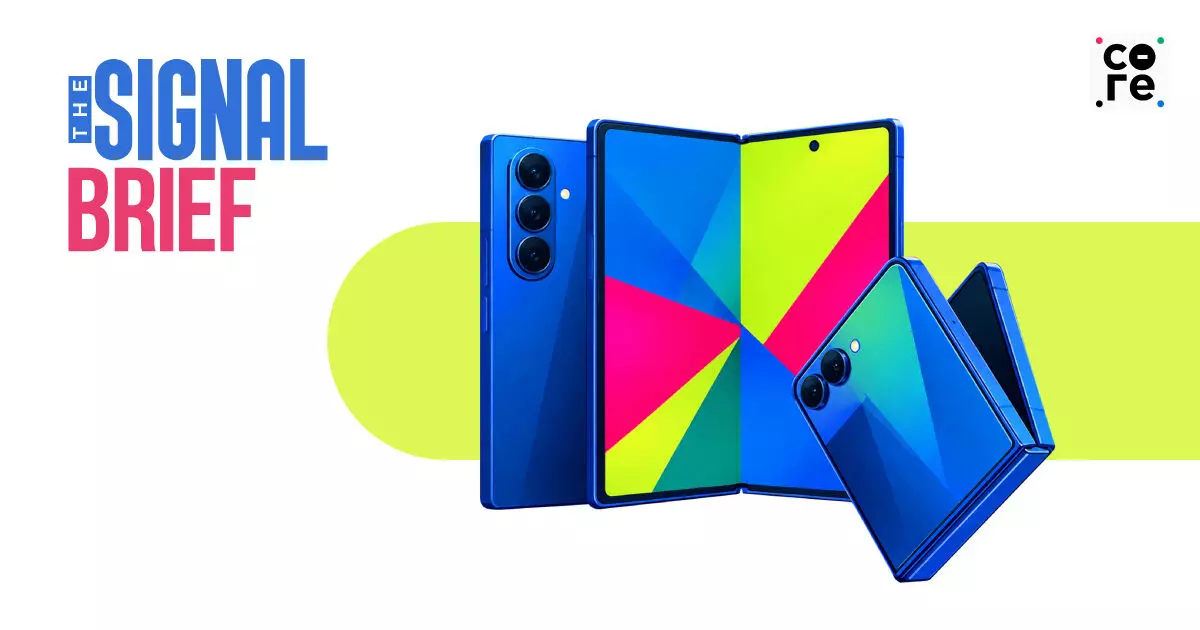
What’s The Point Of A Foldable Phone?
- Podcasts
- Published on 25 Sept 2026 7:40 AM IST

Consumers and experts tell us the pros and cons of buying one.
A few weeks ago, Apple did something it almost never does.
It changed the shape of the iPhone.
The new release is called the iPhone Duo.
Closed, it looks like a regular phone. Open it, and it becomes a small tablet: a foldable phone.
But here's the thing, foldables have been around for years, and they're expensive too.
Google, Motorola, and Samsung's foldables start at around 80,000 rupees.
Apple's Duo starts at just under 3 lakh in India.
So why buy a foldable? What do you really get for that money? And what are its downsides?
To find out, tune in to the latest episode of The Signal Brief.
The Core produces The Signal Brief. Follow us wherever you get your favorite podcasts.
NOTE: A machine transcribed this episode. A human has looked at this text but there might still be errors. Please refer to the audio above, if you need to clarify something. If you want to give us feedback, please write to us at [email protected].
TRANSCRIPT:
Kudrat (Host): Earlier this month, Apple did something it almost never does.
It changed the shape of the iPhone.
Their new release is called the iPhone Duo.
Closed, it looks like a regular phone. Open it, and it becomes a small tablet. A foldable.
Samsung’s social media team started posting mid-release. Things like: “Let us know when you’re done reheating our leftovers,” and “Congrats on finally joining the party.”
Some people found it funny. Some said Samsung was coping.
In India, people went straight to the number.
In the US, the iPhone Duo begins at about two thousand dollars.
In India, it costs Rs 2,99,900, almost a thousand dollars more.
Here, people joked that Duo means two jobs. Someone compared it to a Royal Enfield. The kidney jokes–about how you’d need to sell a kidney to afford this phone, returned.
Kudrat (Host): Foldables have been around for years.
Samsung started making them in 2019.
You can also buy one from Google, Motorola. And now, Apple has officially entered this category.
And foldables aren't cheap. Prices start at around Rs 80,000 for some flip phones, go well past Rs 1 lakh for book-style folds, and reach nearly Rs three lakh for Apple's.
So what exactly are you getting for that money?
Kudrat (Host): My name is Kudrat Wadhwa and you’re listening to The Signal Brief.
You’re listening to our Friday episode, where we tell stories about how Indians live, work and spend.
Today: are foldable phones worth the price?
Tarun: It's a very important time for a new category within smartphones. So if you look at historically what has happened, there has been a kind of plateau in terms of hardware innovation within these form factors.
Kudrat (Host): That was Tarun Pathak, he’s a research director at Counterpoint Research.
He spends his time watching how phones get made, sold, and used both in India and globally.
When he says the hardware has plateaued, he means this: for years, a new flagship has generally been a sharper camera, a faster chip, a slightly different bump on the back. The rectangle in your hand stayed a rectangle.
But that’s changed now, with foldables.
Tarun: Apple, as we all know, they are never first to a category, but they are known for entering into a category when they think the timing is right in terms of the supply chain, the components are evolved, or even the scale, what they think they can get. Because Apple has a very diverse and robust supply chain.
Apple's entry will actually drive a lot of interest in this category. Which means you'll find new users coming to this category, first-time adopters, especially when Apple has a very loyal user base and someone who look Apple as a very aspirational brand.
Kudrat (Host): Until now, the big names selling foldables in India are Samsung, Motorola, and, for a smaller set of people, Google.
Samsung and Motorola sell both kinds. The flip, which opens upwards, is similar to the phones many of us used in the early 2000s.
And the book style, which opens sideways, into a wider screen.
Google, so far, only sells the book.
The flip sits at around eighty thousand to a lakh rupees. The book climbs from there, often to a lakh and a half, sometimes more. Apple’s Duo starts at just under three lakh.
Tarun told me that this category in India has been selling about six lakh units a year until now.
With Apple in the mix, and Samsung pushing harder, he thinks it might touch a million. That sounds like a lot until you put it next to the rest of the market.
This year, India may sell about 13 crore smartphones. A million foldables, if it happens, is still a sliver.
So, who’s buying these phones?
One buyer is Heena Goswami, an academic turned public policy practitioner. She owns a flip-style Samsung.
Heena: The first flip phone that I got was Samsung Flip 4 or 5, and it was in pink. And that was all the reason I needed to get a flip phone. And it looked like a cigarette case, or it looked like a, I don't know. I mean, I did not have any utilitarian reason to buy a flip phone.
Kudrat (Host): For Heena, nostalgia did more work than any spec sheet.
Heena: When I was young, all my friends had these QWERTY keypad phones which would, like, slide. And I mean, they would slide. I didn't have one. So, like, you know how people make bad use of adult money? That's what I decided to do when I started earning, and I got myself a flip phone.
I wanted to slam the phone down. Nobody knows it. Nobody would know it, but, you know, I just wanted to do.
Kudrat (Host): Heena bought hers because she wanted to experience the feeling of slamming her phone shut.
But most other foldable buyers have a different reason.
The extra screen can make your phone a much more useful work device.
Navkendar: I'm Navkender Singh. I'm part of International Data Corporation, worldwide team. I'm based in India. I look at all the devices research and robotics for the worldwide.
So one of the use cases for me in the Fold is when I unfold, you know, my Fold, I can put two screens together and still it's, it's, it's equal to two phones holding and two... So I can cross, you know, function with two or three things at the same time. So if I'm in a call with you, let's say with you, I can still do it, and if I have to refer to a data point or, you know, some, some narrative, I can open that window or my browser or whatever or my email on the other side and still speak to you. So I think that allows for that multi-productive, you know, window capability is very, very important.
Kudrat (Host): To that end, the people buying book-style folds tend to be working professionals who can live with a phone that costs well over a lakh.
Here’s Tarun of Counterpoint again.
Tarun: If you look at existing install base when we look at, these are the predominantly working professionals, who have been using this category, who are above 40 years of age, you know, who are using these devices more from a productivity point of view. You can have multiple apps open, you can do more work on the go.
Kudrat (Host): Tarun added that in India, the book still beats the flip.
Tarun: Even now, we split the foldables into book type and a flip factor. And the book type is almost like two-thirds of the sales compared to almost like half of the sales a couple of years back.
Kudrat (Host): One of those book-fold users is Rajneil Kamath. He described himself as a consumer tech enthusiast.
Right now he carries two phones: a Google Pixel 11 Pro Fold, and an iPhone.
Rajneil: I do think that for most people, if productivity is something you want to do, a foldable is life-changing in that sense. You just realize that the flexibility you have to work from wherever with a slightly bigger screen, it's very liberating.
Many times, a lot of my work includes reviewing Google Docs, and it's easier to do it on a larger screen than it is on a candy slab, like a, you know, a candy bar slab phone. So whether it's having side-by-side windows when you're wanting to do like a search and then respond to something, whether it is going through your documents, whether it's chat, even social media, usually you'll see me have like YouTube on one side and X open on the other side. So I'm able to like look at two things, cross-reference and do things together. So the multi-screen experience on a foldable is a lot better than merely doing it on a candy slab phone.
Kudrat (Host): I asked him why he doesn’t just opt for an iPad. He says he does own one but can’t carry it everywhere. The fold, then, is the biggest screen that is already in his pocket when he is moving.
He also told me he picked the Pixel Fold over Samsung on purpose.
Rajneil: The Pixel, for example, is IP68 rated. That's not the same rating that the Samsung phones have. To me, the thinness of those Samsung phones didn't matter as much, as much as durability does, because you don't want a delicate phone. You do want a fairly sturdy phone as well. Foldables, as it is, the hinge usually is complicated technology, and then you don't want like one small speck of dust or like some water drop somewhere to ruin it. So durability does matter. So for me, the Pixel scored over the Samsung.
Kudrat (Host): But the bigger screen comes with a trade-off. The technology that makes a foldable useful is also what makes it more vulnerable.
The hinge, the flexible display, the thin body: all of it has to survive being opened, closed, dropped and carried around every day. And when something does go wrong, the repair bill can be hefty.
Here’s Tarun of Counterpoint again, a foldable user himself.
Tarun: So one is the repair cost. So in fact, even if it is my fifth, sixth foldable, my previous versions all had some issues with the display, right? And display is a major part of the phone. Let's say you are investing almost like one and a half lakh rupees on any foldable, and then you end up dropping it, because durability in these form factors is also not to the level of what we see in the regular phones.
Then you have to maybe spend close to like 70, 80K just to repair the display. And that is something, which is, the cost of repair is something which has made some of the user not to go into that. But things are getting better.
If you have to, you can take insurance on these devices, protect plans are there. But again, the ease of repair and the repairability index is something which was pushing people in that direction.
Kudrat (Host): Heena, the consumer we previously heard from, says she witnessed her screen changing shape in her previous flip phone.
Heena: The first flip phone I got was a Samsung Flip some model, and it's a rich, like it's an expensive phone, but I'm pretty cheap. So I still have a cover. And I'll tell you what happened with the first phone I got. It was, I think, an year around... It had been an year that I had that phone or less than an year, and the screen, like this, this curve that you saw, it's hinged now also. So it got hinged. Then I didn't want to have that hinge and I didn't want to have that curve on my screen, because it did not make the experience so good.
So I decided to upgrade the phone and in less than an year, for a phone that I had bought for about a lakh, I paid around 70,000 and upgraded to a higher model. So not really worthwhile. And they tend to get hinges, like, really easily.
Kudrat (Host): Money, of course, is the wall everyone names first.
Navkendar of IDC names the others, the ones you only notice after you have already paid.
Navkendar: Thirdly has been the camera. Camera has not been up to the mark versus the other flagship because you are paying that price, but you're not getting the same kind of camera. And the fourth has been the battery performance because it's a thin device, while the batteries are on both the sides even with the iPhone Duo.
But I think battery backup versus some of the other flagship has been lacking. I think these are some of the things, obviously the price being one of the most important ones because, if you buy a Moto Razr and even a Samsung Flip, they're also at about 80,000, 90,000, 1 lakh, and the battery is, is not so great because it's, it's a small, a small device. You can only have so much battery in that small real estate. So I think these four or five features have been inhibiting it apart from price.
Kudrat (Host): So, foldables can offer a boost in productivity as Rajneil and the analysts mentioned.
But that comes at a hefty price and other downsides like a poor camera and potentially high repair costs.
Given all this, Navkendar believes that foldables will likely not pick up in a mass way anytime soon.
Navkendar: It will remain a super premium product. It will remain a premium and a super premium kind of product. Flip and that one can be still had at around same other flagships, but I think Folds will remain a, a, you know, niche category in and of itself.
Kudrat (Host): And maybe that's the thing about foldables. They don't have to make sense for everyone to make sense for someone.
Heena: I love having it. Like, I love having it. You know, there's nothing spectacular about it in terms of features. It's just cute and, you know, it's just a nice conversation starter. But yeah, I, I wouldn't suggest somebody to spend that kind of money and get this phone, but I think I would still go for this phone again.
Outro: That's all for today. You just heard The Signal Brief, your twice-a-week look at the stories shaping how Indians live, work and spend.
The Core produces The Signal Brief. Follow us wherever you get your favourite podcasts.
To check out the rest of our work, go to www.thecore.in.
If you have feedback, we'd love to hear from you. Write to us at [email protected] or you can write to me personally at [email protected].
Thank you for listening!


